

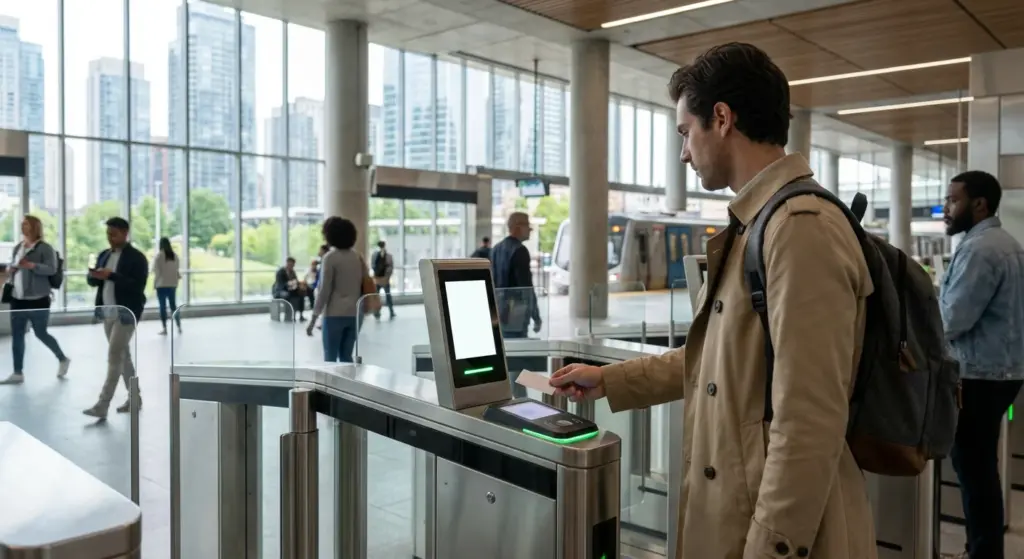
Imagine boarding any bus, tram, or metro in any city and paying the same way you unlock your phone: one tap, no thinking, no queuing, no apps to configure. That’s the promise behind Mastercard’s transit framework — and it’s quietly becoming the blueprint modern cities adopt when they want friction-free mobility.
What the Framework Actually Does
Behind the scenes, transit systems are messy: validators, acquirers, fare rules, clearing houses, risk scoring, settlement timelines.
Mastercard simplified this into one end-to-end playbook that any city can adopt:
- Common standards for validators and terminals
- A predictable risk model for low-value transit transactions
- APIs for fare capping, discounts, multi-modal journeys
- A certification process so hardware “speaks the same language”
- A settlement and reconciliation backbone that operators don’t need to reinvent
In short: a city can move from “paper tickets and queues” to “tap-and-go everywhere” without building custom infrastructure from scratch.
Why Cities Adopt It So Fast
✔ It removes friction for passengers
You tap your card or phone, gates open, and the ride begins.
No apps. No ticket machines. No confusion about zones or fares.
Cities consistently see:
- Faster boarding
- Shorter queues
- Happier riders and smoother driver flow
The best mobility tech is the one you barely notice.
✔ It simplifies operations for transit agencies
Instead of juggling incompatible legacy systems, agencies get a clean architecture:
- Standardized risk and settlement
- Unified fare logic
- One set of rules for all modes (metro, bus, tram, ferry)
- Fewer vendor-specific headaches
This reduces the administrative load and cuts years off implementation timelines.
✔ It makes multimodal transport feel like one network
Right now, buses, metro, bikes, scooters, EV chargers, and ferries often operate in silos.
With Mastercard’s framework, cities can stitch them together into one seamless experience:
One tap → one account → one daily/weekly cap across all modes.
No more juggling different apps and cards.
✔ It cuts cost and speeds up deployment
Because cities follow a proven model, they avoid the expensive “custom project trap.”
Benefits include:
- Lower integration cost
- Faster certification
- Predictable settlement
- Less bespoke software
This is why medium-sized cities adopt it even faster than global capitals — the ROI is immediate.
Why Riders & Drivers Should Care
For most people, this is not a payments story — it’s a comfort and time-saving story:
- No topping up a transport card
- No figuring out fare zones
- No paper tickets
- No queues behind confused tourists
- No broken vending machines at 7 a.m.
For drivers, the benefits are indirect but real:
- Faster boarding means less congestion at stops
- Park-and-ride flows improve
- Traffic planners get better data for signal timing and routing
Smooth passenger flow = smoother traffic flow.
Why Mastercard Is Winning the Standard
Plenty of companies tried to modernize transit payments. Only a few understood the complex alignment needed across banks, acquirers, city authorities, software vendors, and hardware manufacturers.
Mastercard’s advantage is coordination and global reach:
- Deep integration with banks worldwide
- A risk model tailor-made for high-volume, low-value transit transactions
- A global certification ecosystem
- Tools for operators to manage fare capping, concessions, discounts
- Predictable settlement and reconciliation
Cities don’t adopt it because of the brand — they adopt it because it works on day one and scales globally.
The Global Direction of Travel
Urban mobility is shifting toward account-based travel, where your card, phone, or digital ID becomes your universal ticket.
Mastercard’s framework is becoming the backbone enabling:
- Mobility-as-a-Service (MaaS) integrations
- Real-time fare optimization
- Combined trips (bike + metro + EV charging + parking)
- Cashless transit systems
- Smarter routing and congestion management
Every city that adopts the framework becomes part of a growing international network where movement feels borderless.
What’s Next
Expect three major developments:
- Expansion beyond public transit — to EV charging, parking, taxis, micromobility, ferries.
- More dynamic pricing — off-peak fares, congestion-based pricing, event-driven adjustments.
- Cross-city and cross-country interoperability — your preferred payment method becomes your global mobility key.
Urban mobility is evolving fast. Cities want simplicity. Riders demand convenience. Operators need reliability.
Mastercard offers a global recipe that solves all three — and that’s why its transit framework is on track to become the worldwide standard.