

Cities spend billions trying to fix congestion, yet one of the most effective tools is hiding in plain sight: the traffic light.
A smarter light — one that listens, learns, and reacts — can remove the kind of everyday jams that drain time, money, and patience. And it does this without digging new tunnels or building new highways.
Why traffic lights became the bottleneck
Most signals still run on rigid cycles designed years ago. Morning rush, evening rush — that’s the pattern. But real traffic never behaves that neatly. One rain shower, a delivery truck blocking a lane, a school event ending five minutes early — and the whole grid freezes.
Drivers feel it instantly. You sit at a red light with no cars crossing. The system keeps ticking, blind to what is actually happening on the street.
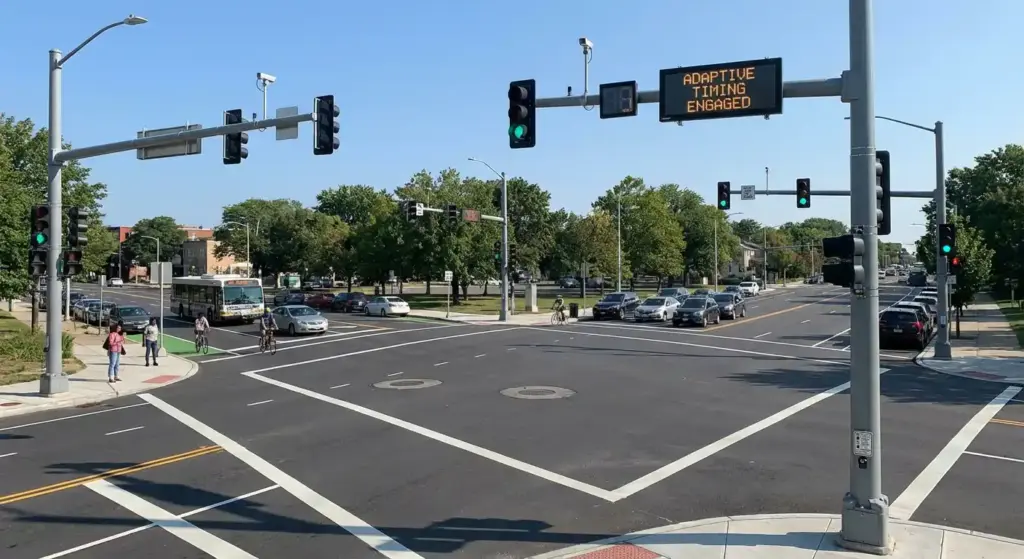
What a smart traffic light changes
A modern traffic light is no longer a timer. It is a sensor hub and a decision-maker.
It uses:
- Computer vision to count cars, bikes, and pedestrians in real time.
- Acoustic sensors to detect approaching sirens and clear a path for emergency vehicles.
- Vehicle-to-intersection signals from connected cars to anticipate demand, not just react to it.
- Machine-learning models to adjust timings dynamically, second by second.
This transforms the intersection from a fixed schedule to a living system.
For drivers, the effect is simple: fewer pointless stops, smoother flow, shorter travel times.
How cities see the benefits
Mayors don’t need multi-year megaprojects. A single intersection upgrade can be installed overnight. When deployed across a corridor, the effects appear within days.
What cities typically observe:
- 10–40% reduction in delays on busy corridors.
- Sharply fewer stop-and-go cycles, cutting emissions without touching a single engine.
- Better bus punctuality, because signals prioritize delayed routes when needed.
- Faster emergency response, sometimes by several minutes.
For many municipalities, this is the dream scenario: visible impact, low disruption, scalable deployment.
What this means for everyday drivers
To the average driver, a smart light feels like magic. You notice fewer “why am I waiting?” moments. Green waves appear naturally, not just at 2 a.m. The city feels lighter and more predictable.
And because the system is data-driven, it spots problems early:
An intersection that regularly clogs at 15:40 each day? The algorithm adjusts.
A blocked lane creating abnormal queues? Timings shift until the obstruction clears.
Drivers don’t see the algorithm working — they simply feel the stress disappear.
The real revolution: connected cars talking to intersections
The next leap is already happening. Some manufacturers allow vehicles to send real-time position and speed to traffic systems.
Intersections, in turn, can send countdown-to-green or eco-timing advice back to the vehicle.
For drivers, this means:
- smoother braking,
- fewer harsh accelerations,
- predictable travel along a corridor.
For cities, it means traffic systems finally have eyes beyond the intersection.
Why this matters now
Urban mobility is moving toward quiet improvements: fewer losses at each intersection, more precision, more responsiveness.
Drivers rarely notice the technology — they notice the absence of chaos.
And as EV adoption grows, last-mile deliveries expand, and cities get denser, intersections become the pressure points. Smart signals are one of the few tools that scale faster than the problem.