

When buses arrive exactly when they should, bikes are waiting where you need them, and traffic lights seem to understand you — that’s AI quietly coordinating your city in real time. This piece shows how data-driven mobility can make everyday movement feel almost magical.
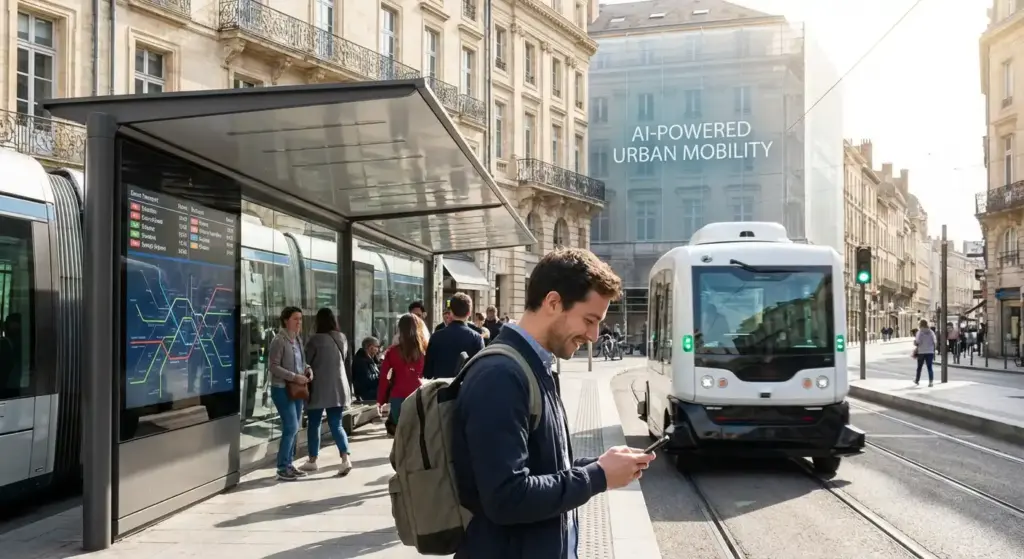
Cities don’t become “smart” through slogans — they do it through thousands of tiny real-time decisions. When to send the next bus. How to rebalance e-bikes before rush hour. When to turn a traffic light green for an ambulance.
AI is finally good enough to handle this complexity at scale. And the result is not a futuristic dream: it’s smoother commutes, fewer traffic jams, and a city that quietly adapts to how you live every day.
Real-time bus routing: when data replaces guesswork
Cities used to plan buses like they planned textbooks: once a year. A printed schedule, a hope, and a lot of patience.
AI flips this logic.
Millions of data points now stream into one place:
- GPS from every bus
- live passenger counts
- weather, road incidents, school patterns
- demand signals from events and neighborhoods
Instead of “line 42 runs every 15 minutes,” the system thinks like a dispatcher with superpowers:
- “Crowd forming at three stops ahead — send an extra bus.”
- “Traffic just froze — reroute two buses and update connections.”
- “Rain incoming — expect more riders soon.”
Passengers simply feel: fewer no-shows, smoother transfers, and trips that behave the way daily life actually works.
The secret ballet of bikes and scooters
Shared bikes and scooters only work when they’re:
- available
- functional
- in the right place at the right moment
Without AI, operators were constantly firefighting. With AI, fleet management turns into choreography.
The system predicts:
- where stations will empty
- which docks will overflow
- when morning hills and evening riverfront trips peak
- which vehicles show early signs of wear
Behind the scenes:
- a van shifts 12 bikes before rush hour
- weak batteries get swapped proactively
- broken vehicles disappear fast
To riders, it feels seamless: fewer empty docks, fewer dead batteries, more “grab-and-go” moments.
Traffic lights that actually seem to understand you
Most intersections still use logic from the 1970s.
AI finally modernizes them.
Signals now respond to:
- crowded cycle lanes
- delayed buses
- emergency vehicles
- slower pedestrian groups
- weather that affects movement speed
This unlocks:
- green waves for cyclists
- priority for full buses instead of empty cars
- safer, longer walk phases when needed
- automatic emergency corridors
You notice it in small moments: “That light waited for us.”
Urban space starts feeling human again.
Why this is more than “smart city” hype
AI won’t magically remove congestion, but it eliminates the dumb, avoidable congestion: badly timed lights, mismatched routes, and pure planning guesswork.
It gives planners x-ray vision — what people actually do, which lines matter, which streets hurt.
It doesn’t force you into one mode. It makes switching modes feel natural: bike → bus → train → walk.
A well-run, data-aware city quietly gives you back something valuable: predictability.
What citizens can shape today
You don’t need to be an engineer to influence AI mobility. Citizens can push for:
- clear goals: are we optimizing car speed or people movement?
- transparency: what data drives planning?
- accessible mobility data for community projects
- priority for buses, cyclists and pedestrians where it creates real benefit
- protected infrastructure that works hand-in-hand with smart signals
AI won’t decide what kind of city you live in. People will.
AI simply gives cities sharper tools and better awareness.
The quiet revolution: a city that pays attention
The real future isn’t drones or self-driving cars everywhere.
It’s a city that listens:
- notes when neighborhoods grow
- adjusts timings after near-misses
- smooths out everyday friction
- respects your time with fewer pointless delays
AI in mobility isn’t about automation. It’s about attention.
A city that adapts to you, your family, your rhythm.
You’ll know it’s working the day you get home and think:
“That was easier than I expected.”